When people hear “security,” their minds usually jump straight to firewalls, passwords, and antivirus software. That instinct makes sense in a digital-first world — but it also creates a blind spot. No matter how sophisticated your cybersecurity stack is, none of it matters if someone can walk through an unlocked door, plug a USB drive into an unattended workstation, or simply wheel a server out the back entrance.
Physical security is the foundation everything else sits on. Here’s how to think about it properly.
Why Physical Security Still Matters in a Digital World
It’s easy to assume that as more business moves to the cloud, physical security becomes less relevant. The opposite is true. Cloud providers still run physical data centers. Remote employees still work from physical laptops, in physical homes and coffee shops. Offices still store paper records, backup drives, and hardware that can be stolen or tampered with.
A hacker doesn’t always need to break an encryption algorithm. Sometimes it’s far easier to walk into a building, tailgate through a door behind an employee, and access a network from the inside.
The Core Layers of Physical Security
Most effective physical security programs are built in layers, so that if one fails, another catches the gap. A useful way to think about it:
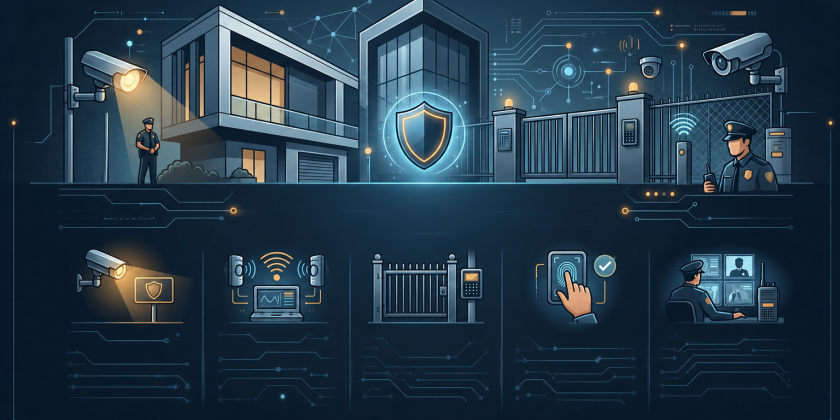
1. Perimeter security This is the outermost layer — fences, gates, lighting, and natural barriers like landscaping that make unauthorized access harder and more visible. Good perimeter design isn’t about making a space look like a fortress; it’s about controlling where people can and can’t go without drawing attention to itself.
2. Access control This covers who can get into a building, and which areas they can reach once inside. Modern systems range from simple locks and keycards to biometric scanners and mobile credentialing. The goal isn’t just to keep unauthorized people out — it’s to create a reliable record of who went where, and when.
3. Surveillance and monitoring Cameras, motion sensors, and alarm systems serve two purposes: deterring bad actors before they act, and providing evidence and context if something does happen. The best surveillance setups are monitored in real time, not just recorded for later review — the difference between catching an incident as it happens versus discovering it the next morning.
4. Human factors Technology alone doesn’t secure a space — people do. Untrained employees holding doors for strangers, sharing access badges, or leaving sensitive documents on desks can undo even a well-designed system. Security awareness training and a culture where employees feel comfortable questioning unfamiliar faces are just as important as the hardware.
5. Response and recovery planning Even the best prevention systems fail sometimes. Having a clear plan for what happens after a breach — who’s notified, how the area is secured, how the incident is documented — determines how much damage a single failure actually causes.
Common Physical Security Mistakes
A few patterns show up again and again in organizations that experience physical security incidents:
- Tailgating tolerance. Employees hold doors open for people without badges out of politeness, unintentionally bypassing access control entirely.
- Outdated access lists. Former employees, contractors, or vendors retain building or system access long after their relationship with the organization ends.
- Unsecured hardware. Laptops, servers, and backup drives left in unlocked rooms or in plain view of windows.
- Overreliance on cameras. Footage is only useful if someone is watching it, or if it’s reviewed quickly enough to act on.
- Treating physical and digital security as separate teams. In reality, they overlap constantly — a stolen badge or an unlocked server room is a cybersecurity incident as much as a physical one.
Practical Steps for Strengthening Physical Security
You don’t need an enterprise-level budget to make meaningful improvements. Some starting points:
- Conduct a walk-through audit of your space from an outsider’s perspective — where could someone get in unnoticed?
- Standardize badge or key deactivation as part of the offboarding process, not an afterthought.
- Lock server rooms and network closets, and log who has access.
- Train staff to challenge or report unfamiliar individuals in restricted areas, without making it feel confrontational.
- Review camera coverage for blind spots, particularly around entry points and equipment storage.
- Treat physical security incidents with the same seriousness and documentation as digital ones.
The Bottom Line
Physical security isn’t a single product or system — it’s a mindset that treats the physical world as part of the same attack surface as the digital one. The organizations that get this right don’t just install more locks and cameras; they build layered systems, train their people, and make physical security part of the same conversation as cybersecurity, rather than an afterthought bolted on separately.
The strongest security programs recognize a simple truth: a network is only as secure as the door leading to the server that runs it.